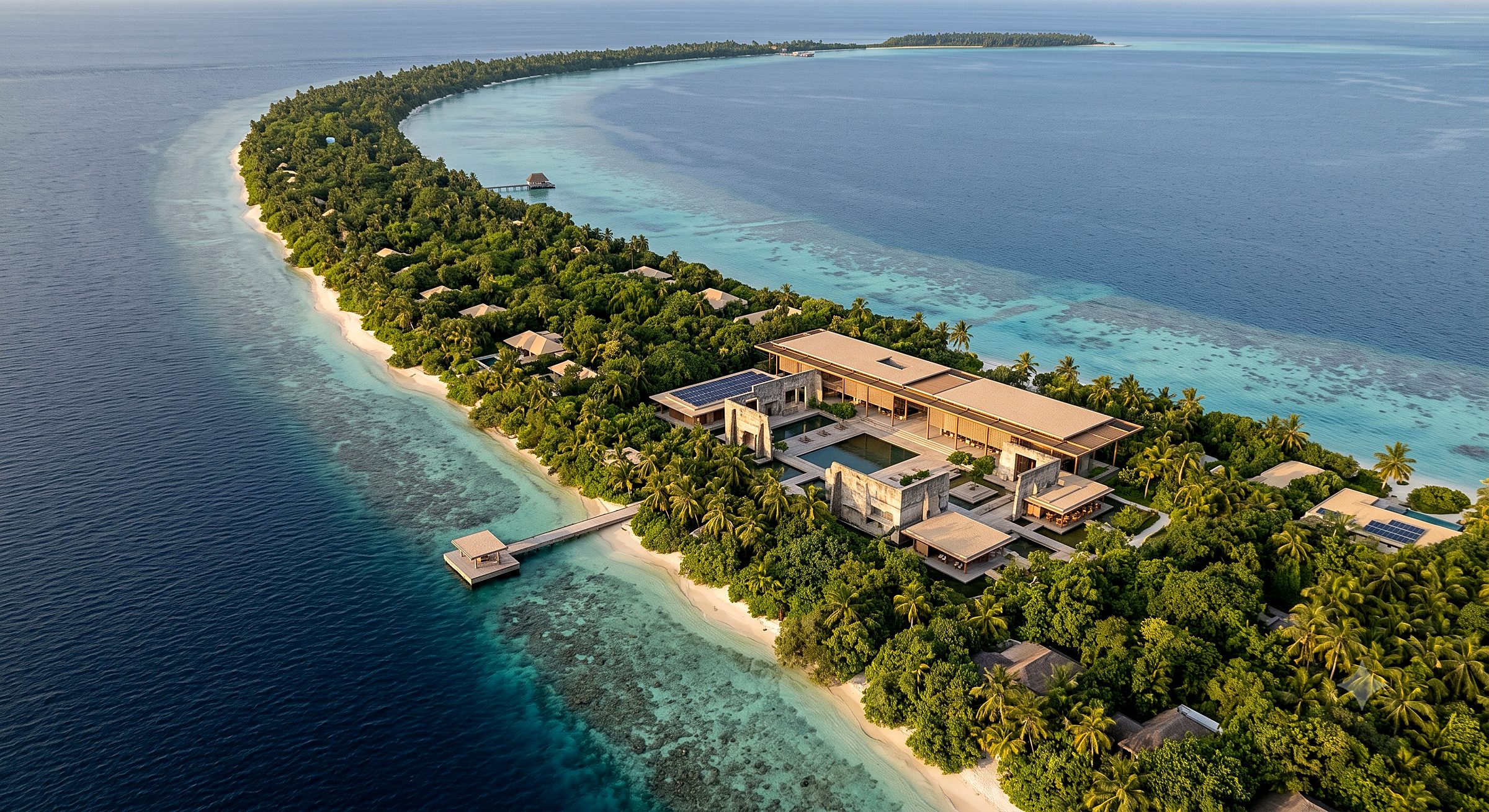
Dholhiyadhoo Ruin Garden
A 20.6-hectare island that already carries the concrete of a resort that was never finished. We do not clear that inheritance away — we build the island's second life around it: 38 keys, restored vegetation, and a forum grown out of the ruins.
Most islands ask for architecture. Dholhiyadhoo asks for repair — and repair, done seriously, is the more demanding discipline.
Dholhiyadhoo sits in Shaviyani Atoll, in the far north of the Maldives — an island publicly listed for resort development, with an unusual inheritance: the structural traces of an earlier resort project that stopped before it opened. Where most sites offer untouched vegetation, Dholhiyadhoo offers disturbed ground, hardened alignments, and mature regrowth pushing through both. The design reads that inheritance as a resource. Ground already disturbed is ground we can use; concrete already cast is embodied carbon already spent. The parts of the island the old project never reached — the beaches, the reef, the older vegetation — are left to keep doing what they have always done.
| Location | Dholhiyadhoo, Shaviyani Atoll, northern Maldives |
|---|---|
| Island | ~20.6 ha · long reef-edge island · disturbed ground and structures from a stalled development |
| Inheritance | Concrete frames, platforms and service alignments — assessed, tested, selectively retained |
| Programme | 38 keys — 30 beach villas · 8 overwater villas · The Ruin Garden Forum · spa gardens |
| Density | ≈1.8 keys per hectare — restoration takes more ground than building |
| Status | Under Ministry of Tourism — resort development |
| Stage | Self-initiated design study — architecture, structure, MEP, BIM |
The second life, in motion.
Down the length of the island — the Forum's thin roof over the old concrete, villas dissolved into regrowth, and the overwater villas kept to the far tip.
Begin where the damage already is.
§03 — Adaptive reuse strategyThe rule of the masterplan is simple: nothing new touches ground the old project did not already touch.
Every hard decision on Dholhiyadhoo follows from that rule. The Forum reoccupies the largest concentration of existing concrete. The service zone reoccupies the old service zone. Former construction routes become shaded paths. And the budget that other projects spend on clearing vegetation is spent here on putting it back — native planting across every disturbed area the new plan does not need.
Reused ground first
New buildings stand on ground that was already disturbed. The island's remaining vegetation is treated as a boundary to work within, not a reserve of buildable land.
The concrete stays
Frames and platforms are surveyed, cored and load-tested; what is sound is kept and put back to work as plinths, water courts, garden walls and rooms. Demolition is the last move, not the first.
Villas on the best beaches
Thirty beach villas spaced sparsely in the regrowth — low timber pavilions with private pools and photovoltaics on their own roofs, reached on foot or by bicycle under canopy.
Overwater, kept rare
Eight overwater villas at the far tip of the island, on short piers clear of seagrass and coral heads — the only new structures that touch the lagoon at all.
Old alignments, new paths
The stalled project's service routes become the resort's shaded walking and cycling spine, and the working island — desalination, wastewater treatment, stores — reoccupies the existing service zone, screened by new planting.
The Ruin Garden Forum.
§04 — The iconic pieceA new roof, floating over what the island already carries.
The Forum gathers arrival, dining, wellness and the island's cultural room into an open-air ensemble built around the preserved concrete. A lightweight timber and steel roof floats above the old fragments; beneath it, the retained walls become plinths and portals, water courts run between them, and spa rooms, shaded gardens and a long pool occupy the spaces the ruin suggests. The light arrives filtered — through the roof's layered edges, through the regrown palms, across raw concrete that has spent years weathering into the landscape.
Nothing about it is a gesture. Each retained element is surveyed, cored and load-tested before it is asked to work again; each new element is light enough to arrive by barge and simple enough to build far from a city. The result reads as memory and measure at once — a room the island could only have grown here.
Restoration is the masterplan.
§05 — Architecture · engineering · ecologyQuiet rooms in a regrown forest
The guest journey runs from water to shade: pier, vegetation, the Forum's filtered light, then a villa somewhere in the green. Villas are calm timber pavilions — deep verandas, private pools, materials chosen to patinate rather than be maintained. Premium is measured in distance from the next roof.
New lightness on old mass
Retained concrete works as ballast and plinth — tested, not trusted. Everything new is lightweight, prefabricated and corrosion-aware, sized for barge logistics; the overwater piers repeat one efficient span on minimal piles, coordinated with the marine and geotechnical specialists who own the lagoon works.
The island gets its ground back
Native replanting across every disturbed area the plan does not need; the reef kept as the first line of coastal defence. Photovoltaics ride the roofs that already exist — the Forum and the villas — with battery storage, desalination with energy recovery, treated wastewater reused for irrigation, no groundwater draw, and dark-sky lighting for the reef at night.
Measured before drawn
Adaptive reuse begins with measurement: the existing structures enter a federated BIM model as surveyed geometry before a single new line is drawn. Tekla detailing and fabrication-level drawings follow — quantities known before they ship, and fewer barge trips for an island that has already paid its construction debt once.
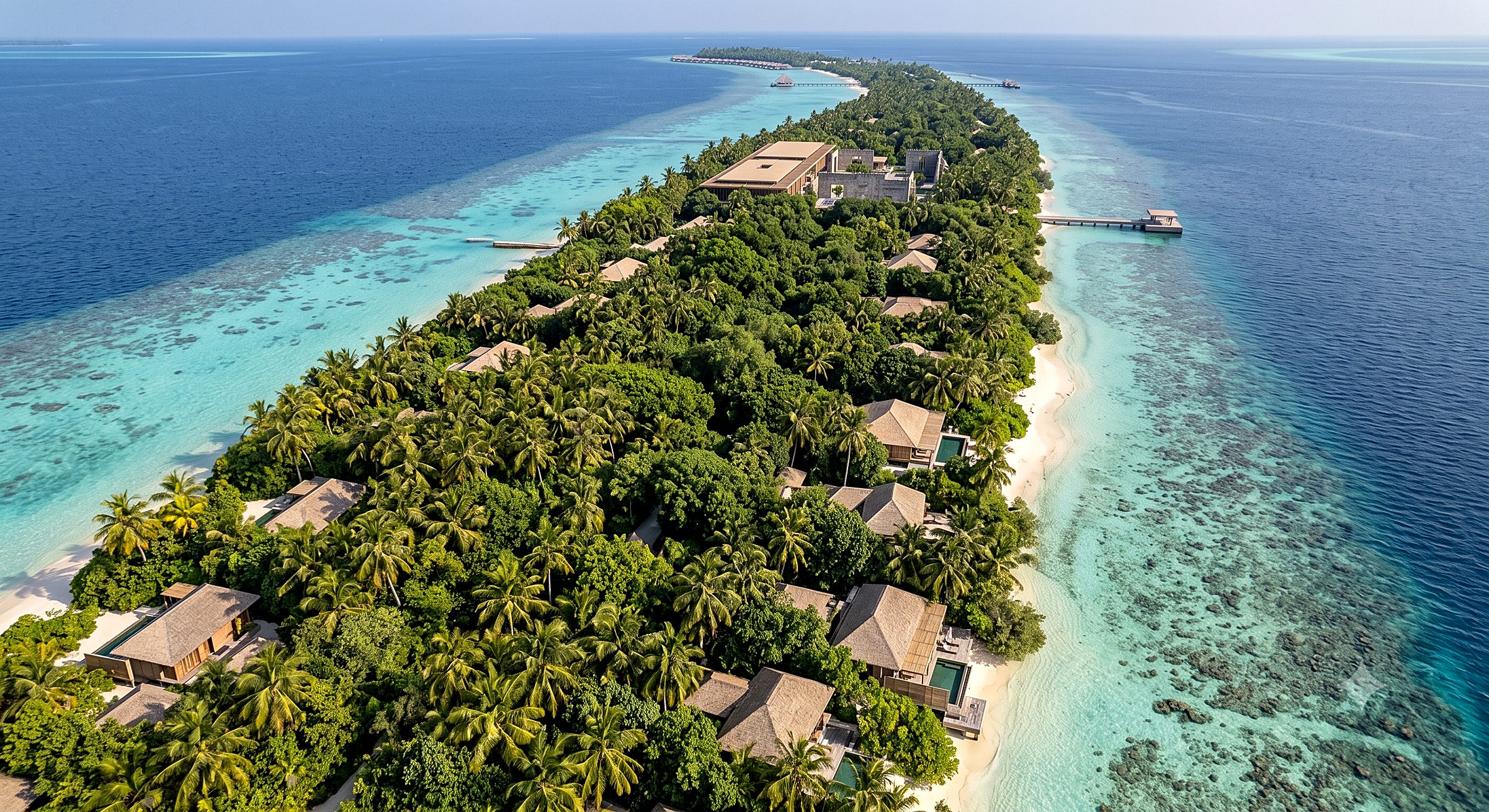
Green over grey.
From above, the buildings disappear first — then the paths. What remains legible is the island.
The concrete stays. The island grows back around it.
Dholhiyadhoo is why this study exists: adaptive reuse is design led by engineering — survey, testing, selective retention, and the judgement to know what is worth keeping. That is our ground. This is a self-initiated design study of a real island and its real inheritance, not a commissioned or built project.
If Dholhiyadhoo — or any Maldives island — became a live project, we would work as the technical partner alongside the Maldives-registered consultants who carry local responsibility: the architect of record, structural checkers, MEP and utilities engineers, and the EIA, coastal and marine specialists responsible for foundations, lagoon works and environmental approvals. Our role is design, structural engineering, MEP coordination, BIM and construction-oriented documentation.