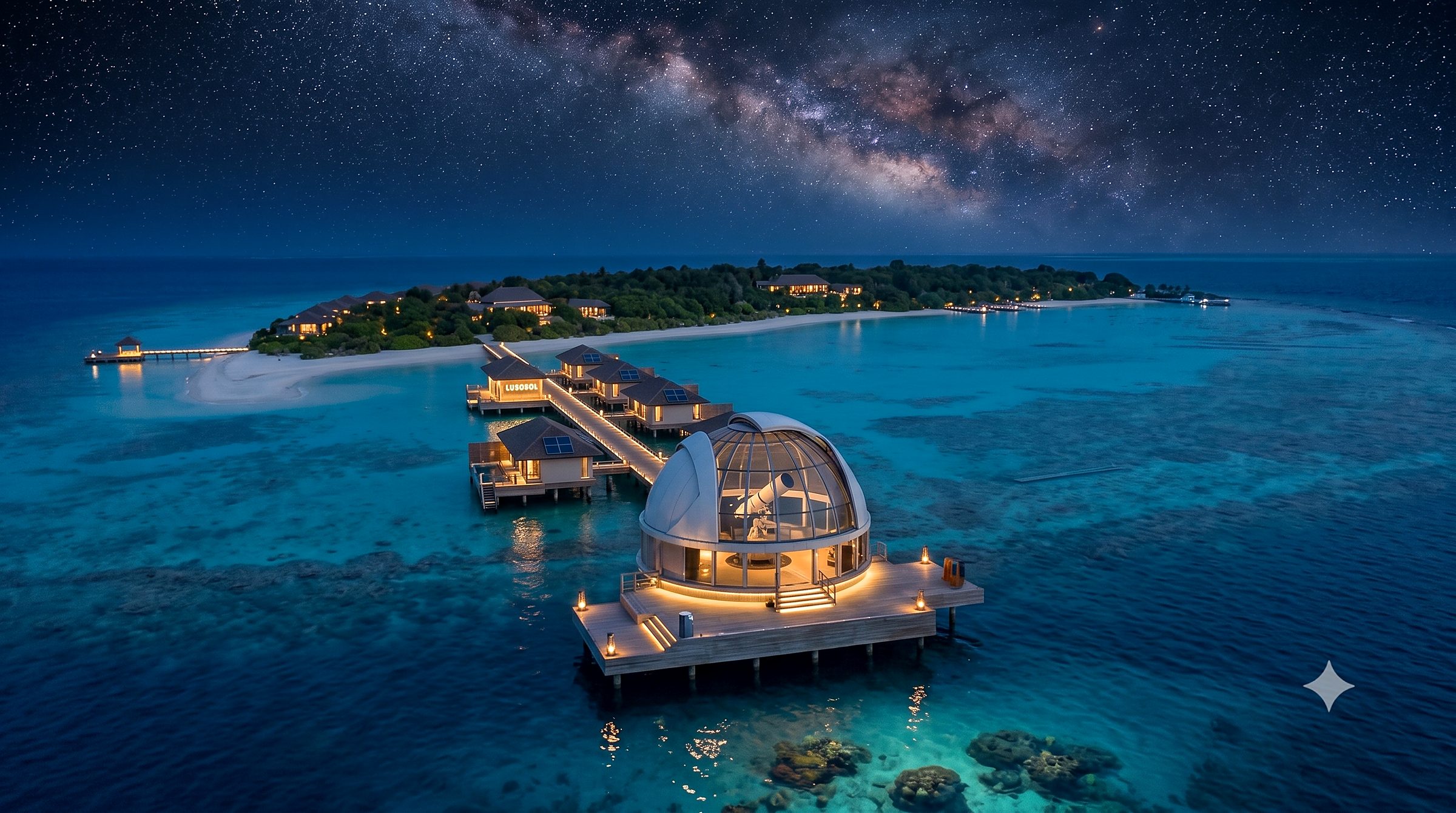
Huivani Celestial Pier
A 20.5-hectare island in Noonu Atoll, planned around the one amenity no resort can build: an unpolluted night sky. Thirty keys, one pier, one observatory — and lighting quiet enough to keep the Milky Way visible from every deck.
Calm by day, legible stars by night. The whole plan is written between those two states.
Huivani sits in Noonu Atoll — an atoll already associated with the quietest end of Maldivian hospitality — inside its own reef ring, with a wide, shallow lagoon opening to the east. The island is modest in size and the design keeps it that way: 24 beach villas behind the vegetation line, a small beach heart, and a single long pier reaching across the lagoon to the reef edge. At night the island dims rather than performs. Lighting is low, warm and shielded — for the guests who came to see the sky, and for the reef, the nesting turtles and the fish spawning cycles that depend on real darkness.
| Location | Huivani, Noonu Atoll, Maldives |
|---|---|
| Island | ~20.5 ha · reef-ring island · wide shallow lagoon to the east |
| Programme | 30 keys — 24 beach villas · 6 overwater villas on the Celestial Pier · observatory · spa |
| Density | ≈1.5 keys per hectare — the night sky needs an empty island |
| Identity | Dark-sky resort — shielded, warm, low-level lighting throughout |
| Status | Under Ministry of Tourism — resort development |
| Stage | Self-initiated design study — architecture, structure, MEP, BIM |
The night resort, in motion.
Down the pier and over the island — villas in the green, the dining pavilion mid-water, and the observatory past the last light.
A small island, planned in one line.
§03 — Masterplan strategyEverything on land stays behind the vegetation; everything on water stays on one pier.
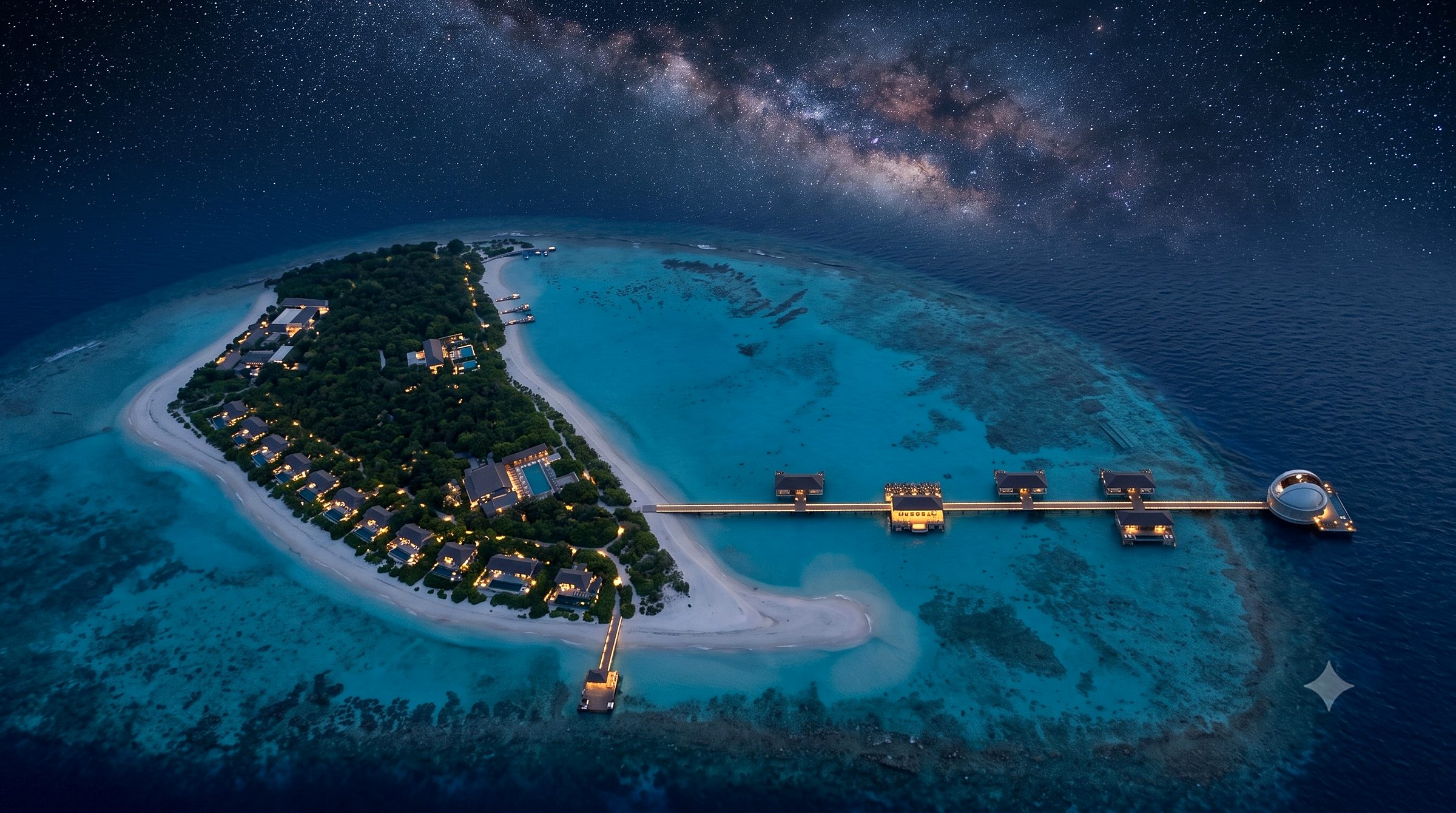
The discipline of the plan is what protects both the island and the night. Thirty keys are read from the plan itself — 24 beach villas along the best frontage with private gardens and pools, and six overwater villas spaced generously along the Celestial Pier, the only structure that crosses the lagoon. Arrival lands on its own jetty to the south, so the pier belongs entirely to the guests who stay and dine on it.
The beach heart
Reception between beach and vegetation, the main restaurant and lagoon-edge pool at the centre of the west beach — a short, shaded walk from every villa, and the only place on the island that gathers.
Villas behind the green line
Twenty-four beach villas held behind the vegetation, each with a private garden and pool, oriented to the beach rather than to each other. The spa disappears deeper into the interior, where the canopy is densest.
The Celestial Pier
One line across the lagoon, carrying everything overwater: arrival deck, water lounge, sunset bar, the fine-dining pavilion at its midpoint, six villas spaced far apart — and the observatory at the reef edge, past the last light.
The observatory
A glazed dome on its own deck at the end of the pier, holding a serious telescope over the darkest water on the island. By day it reads the reef; by night it is the reason the whole resort keeps its lights low.
The working north
The solar field, battery plant and back-of-house group at the island's north end, screened by vegetation and out of every guest sightline — with the arrival jetty kept separate on the south shore.
The Celestial Pier.
§04 — The iconic pieceNot circulation — a sequence. The pier is the resort's second shoreline, laid out from arrival to darkness.
The pier begins where the beach heart ends and unfolds eastward as a series of rooms over water: an arrival deck, a water lounge low enough to touch the lagoon, a sunset bar, the fine-dining pavilion at the midpoint, and six overwater villas — large, far apart, each with photovoltaics on its own roof and steps down to the water. It ends at the observatory, past the last villa and past the last light, where the deck opens to the reef and the sky at once.
Structurally it is one efficient span, repeated — light enough to leave the lagoon bed almost untouched, with piles positioned off the seagrass and coral heads mapped before design began. The lighting along its length is amber, shielded and aimed at the deck, never at the water: the pier must be walkable by starlight.
Darkness, treated as infrastructure.
§05 — Architecture · engineering · ecologyRooms that end in sky
Low volumes, deep shade, and openings composed for two views — the lagoon by day, the sky by night. Bedrooms and decks are laid out so the brightest thing visible after dusk is the Milky Way, not a neighbour's veranda. Materials stay quiet: timber, stone, lime render, weathering into the island.
A pier light enough to leave the lagoon alone
Prefabricated, transportable elements sized for barge logistics and corrosion-aware in every detail; the pier repeats one span on the fewest piles the structure allows, coordinated with the marine and geotechnical specialists who own the lagoon works. The observatory deck is stiffened separately — a telescope needs a structure that does not move with the dancers at the bar.
The night is a habitat
Full-cutoff, warm-spectrum lighting with curfews — for nesting turtles, for the reef's night cycles, and for the sky above the telescope. The solar field at the north end and the photovoltaics on the pier villas carry the daytime load into battery storage; desalination runs with energy recovery, treated wastewater irrigates the interior, and no groundwater is drawn.
Model-based, buildable, measured
A federated BIM model with Tekla detailing and fabrication-level drawings — the pier arrives as a kit of repeating parts, quantities known before they ship. The lighting design is documented fixture by fixture: a dark-sky resort is built in the specification, not the brochure.
Memorable by night.
The island dims, the reef keeps its rhythms, and the pier ends where the darkness is complete.
The rarest amenity in the Maldives is the night itself.
Huivani is why this study exists: a dark-sky resort is won or lost in the technical layers — the lighting specification, the pier structure, the energy balance — which is exactly where this studio works. This is a self-initiated design study of a real island, not a commissioned or built project.
If Huivani — or any Maldives island — became a live project, we would work as the technical partner alongside the Maldives-registered consultants who carry local responsibility: the architect of record, structural checkers, MEP and utilities engineers, and the EIA, coastal and marine specialists responsible for foundations, lagoon works and environmental approvals. Our role is design, structural engineering, MEP coordination, BIM and construction-oriented documentation.